The Saturday Call You Missed Is a Sales Problem
by Babak Nabiee, Founder, BNAB Consulting
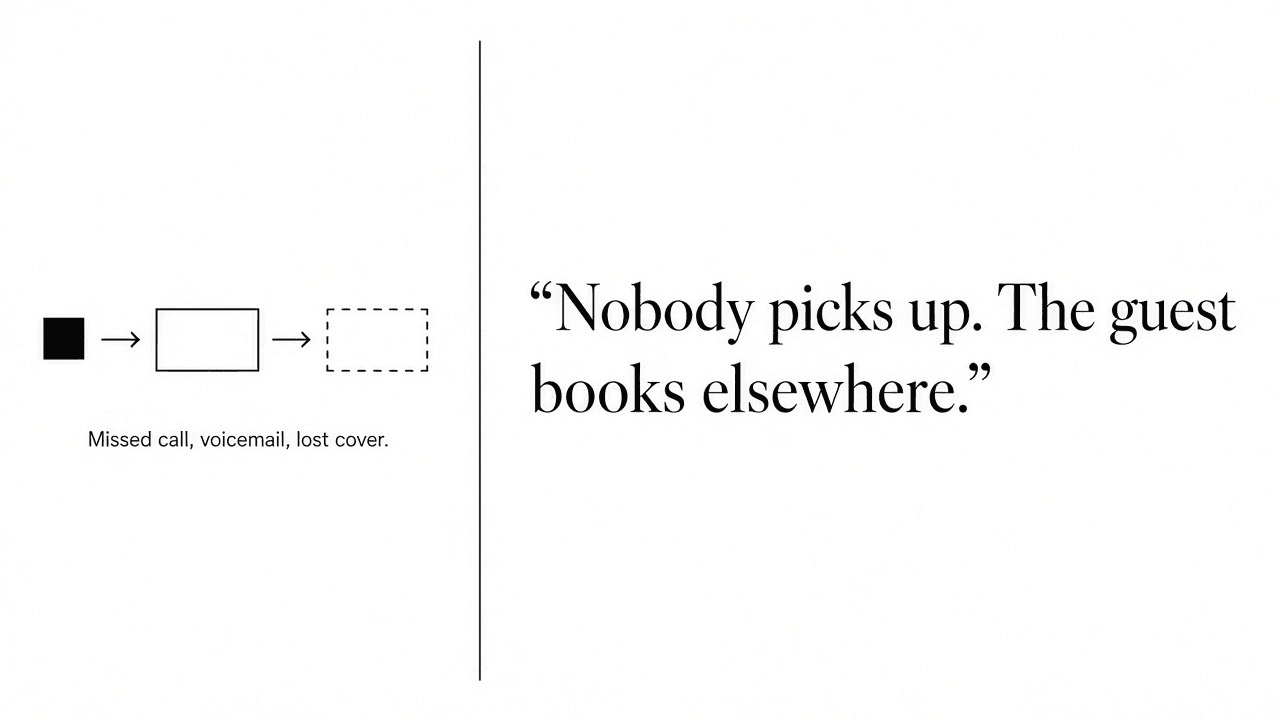
Saturday afternoon. The person at the front is already with a customer. The phone rings. Nobody picks up.
The caller does not leave a voicemail and wait. They call the next place that answers, book there, and your day never sees them. That is not a phone-system story. It is a sales problem: an appointment that went elsewhere, a private-event inquiry that never got a name, a customer who bought from the business that picked up.
Any small business that lives on the phone has this problem. A restaurant mid-seating. A shop with a line at the counter. An online store where the person who answers the phone is also packing the orders. A clinic, a studio, an office, a salon, with everyone already in front of someone. Staff cannot stand at the phone and stay with the customer at the same time. Whichever one wins, the other one costs money.
Voicemail is a closed door with a beep
Most callers will not leave a message about something they need today. They call someone else. By the time anyone checks the box, the table, the appointment, or the job is already somewhere else.
A bot that guesses is worse than silence. If it invents availability, quotes a price it was never given, or promises something you cannot honor, you have not saved a call. You have created a no-show, or a person who arrives already angry because the room cannot match what the phone said.
This is a sales problem, not an IT project
Owners file the phone under "we should get to that" because it looks like software. But the damage does not show up in an IT ticket. It shows up as a quieter book, an empty inquiry list, and customers who never say they called. You do not get a report that those callers chose the place that answered. You get a slower day than it should have been. The loss is invisible, which is why it is easy to file under technology.
For a restaurant or a venue, a missed private-event call is often the larger hole. One birthday or company dinner can matter more than a single table. A shop, a salon, or a clinic is the same shape with different words: Are you open? Do you have it? Can you take me Tuesday? Where do I park? An online store gets its own version: Where is my order? Can I return this? Do you ship there? If the person at the desk is already with a customer, or already at the packing table, the phone is a second counter nobody is staffing.
The useful question is not whether a bot can talk. It is whether the phone protects the sale without lying to the caller, and without pulling your best people off the customer in front of them to repeat the hours.
What "working" means
Working is a short list. If any item fails, the system is not ready for a customer line.
Facts stay locked. Hours, address, arrival notes, return policy, and event details come from what you have approved. When something changes, a person updates the source. The line does not freelance a new closing time because it sounds plausible.
Availability is not invented. If the system does not know whether you can take them, it says so. Your existing book, whether that is a reservation list, an appointment book, or a notebook at the desk, stays the record. The phone respects that book. It does not compete with it.
Leads go to a person. A party, a first appointment, a request to hold a room or a chair: the line takes the name, the date, the size of the ask, and a way to call back, then hands it off. It does not pretend the sale is finished.
A human is always the escalation path. Complaints go to a person. Emergencies go to a person. The caller never has to prove they need one.
Texting happens only after consent. If you already use a booking link, the right move is to text it after the caller agrees to receive it. A venue on OpenTable is one example: the line texts the link after verbal consent. It does not write the reservation into OpenTable behind your back.
That line between help and invention is the product.
What the Voice Host Line is
The BNAB Voice Host Line is a reception service on its own. A small business can put it on the customer line without buying anything else from us. If you already run on BNAB's system, it can sit inside that work. Either way, the line is the product.
It answers so your people can stay with the customer in front of them, or with the order on the table. It handles hours, location, parking, events, and return policy from facts you have locked. It never invents availability. It captures the calls a script cannot close and hands them to a person. It escalates complaints and emergencies. It sits beside the book you already run.
That is a narrower promise than most phone pitches. It is also the one you can leave running while your people stay with the customer.
Start with a call
If the phone is losing calls while your team is with customers, start with a conversation. We will look at how the line works today, what the voice host should and should not say, and whether it fits the way you already take business.
Call (832) 979-6756, or book a discovery call.